
Market Signals
Robot demand growth is spreading beyond automotive
New IFR figures show US installations returning to double-digit growth, with food and non-manufacturing sectors becoming more important automation buyers.
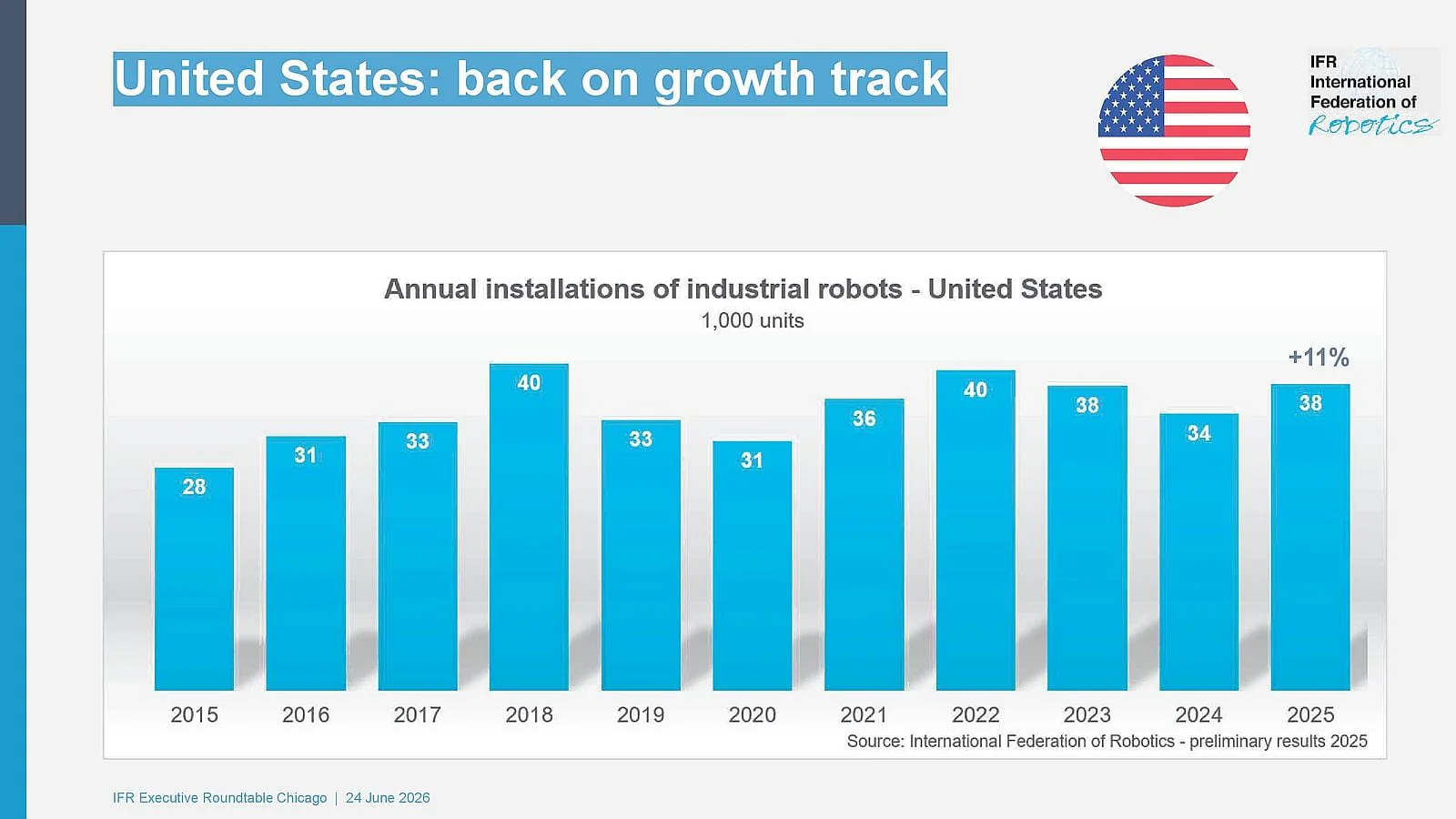
Preliminary IFR data puts US industrial robot installations at 38,000 units in 2025, an 11% year-on-year increase. The more instructive detail is where growth is appearing: food-industry adoption rose sharply while demand continued to diversify beyond automotive.
The numbers behind the signal
Automotive remains the largest US adopter, but IFR reports food-industry installations rising by 30% to roughly the same annual level as metal and machinery and electrical-electronics. Robot density also increased to 307 operational robots per 10,000 manufacturing employees.
China remains much larger by annual installation volume, while Germany and Japan continue to record higher manufacturing robot density than the United States.
What it means for European manufacturers
This is not a direct forecast for Europe, but it reinforces a pattern visible across mature markets: automation is moving into processes and sectors once considered too variable, too low-volume or too dependent on people.
Labour availability, traceability, hygiene, ergonomics and the need for flexible capacity are making application-focused automation more relevant to mid-sized producers.
The Multitech view
Market growth should not be read as a reason to buy a robot. It is a reason to reassess tasks that have become persistent bottlenecks. The best starting points are processes with measurable waiting, inconsistency, ergonomic strain or dependence on scarce skills.
A focused feasibility study remains more valuable than following a broad adoption trend. Market momentum matters only when the individual application makes operational sense.
Practical takeaways
- Automation demand is diversifying beyond automotive.
- Food, metalworking and electronics are strong application territories.
- Use market signals to identify opportunities, then prove each task independently.
This briefing is an original Multitech editorial summary based on the linked primary source. Product claims and figures remain attributable to that source.