
Physical AI
Agentic AI is moving from one robot to the whole cell
A Universal Robots research demonstration used an AI agent to discover and coordinate four cobots through the Model Hardware Standard. The important signal is a possible common layer for orchestrating complete automation systems.
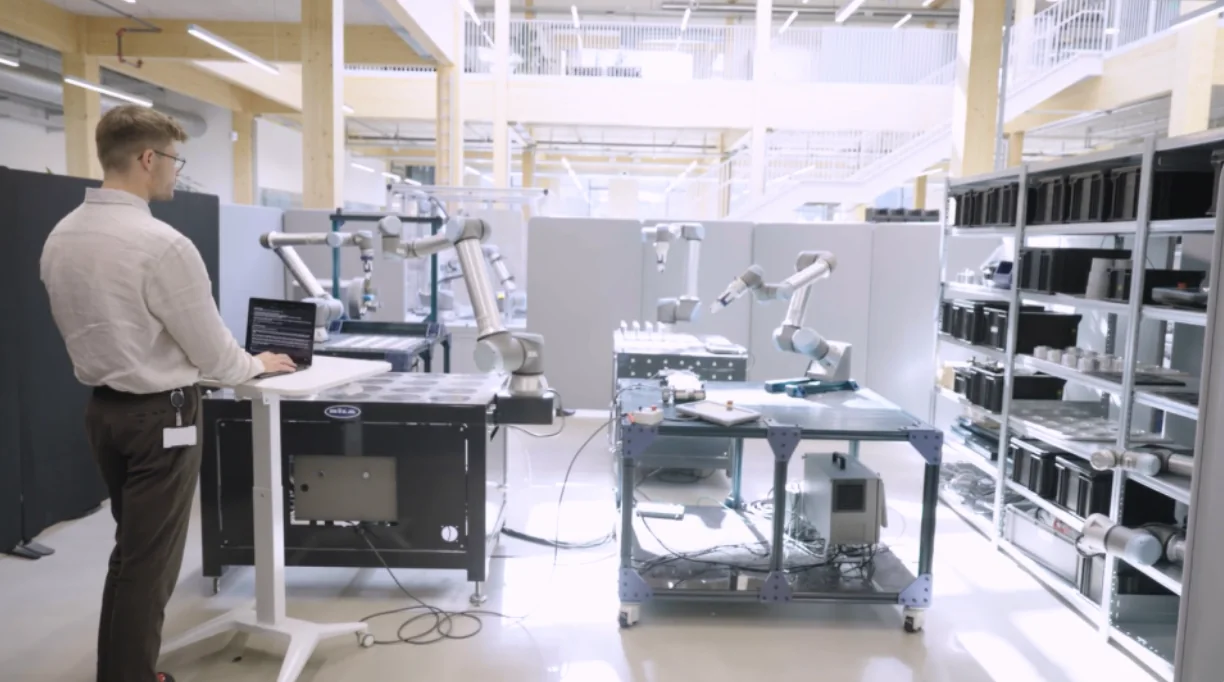
Robot integration consumes considerable engineering time because every machine, interface and operating sequence must work together. Universal Robots' latest proof of concept explores whether an AI agent could eventually assist with that system-level work.
One agent across four cobots
In the demonstration, an agent running Claude discovered four connected cobots, identified their available capabilities and coordinated payload transfers from plain-language instructions.
Universal Robots describes the Model Hardware Standard as a limited research preview. It is not generally available, and autonomous mobile robots have not yet been tested in this implementation.
Intelligence above deterministic control
The experiment keeps the established robot safety architecture underneath the AI layer. Devices communicate operational boundaries, interlocks and emergency-stop information, while deterministic controls retain responsibility for safe execution.
That separation is essential. An AI agent may plan and coordinate work, but it should not replace validated safety functions or predictable machine behaviour.
The Multitech view
The strongest opportunity is faster integration and reconfiguration, particularly where several robots and peripheral devices must cooperate.
Manufacturers should evaluate these systems through measurable tasks: commissioning time, recovery behaviour, process stability, cybersecurity and the ability of engineers to understand and approve the generated configuration.
Practical takeaways
- Separate AI orchestration from certified safety functions.
- Require engineers to review generated configurations and changes.
- Test fault recovery as thoroughly as successful operation.
- Begin with a bounded cell before considering wider factory orchestration.
This briefing is an independent Multitech interpretation of a Universal Robots research demonstration. Multitech is an authorised Universal Robots distributor but did not participate in this experiment. The Model Hardware Standard remains a limited research preview, and the demonstration should not be treated as evidence of general production availability.