
AI & Robotics
Physical AI moves closer to the factory floor
FANUC’s collaboration with Google shows how natural-language instructions and adaptable robot behaviour are moving from research demonstrations toward industrial platforms.
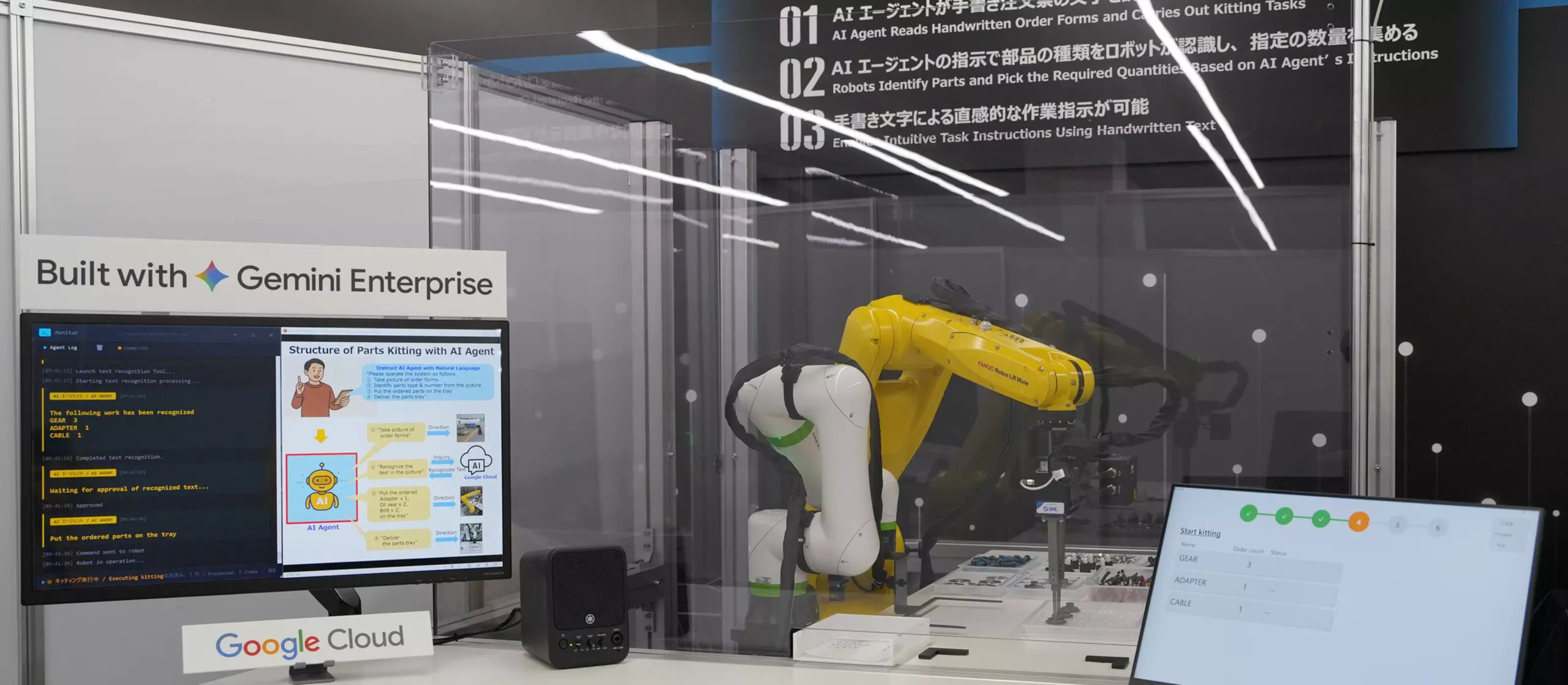
FANUC has announced a collaboration with Google around Physical AI, combining industrial robot platforms with Gemini Enterprise, ROS compatibility and Intrinsic’s software environment. The promise is robots that interpret higher-level instructions and adapt more easily to changing tasks.
From programmed motion to interpreted intent
Traditional cells execute carefully engineered sequences. Physical AI adds perception and decision-making so a system can interpret objects, context and human instructions before selecting an action.
FANUC says its demonstration uses an AI agent to understand natural language, recognise objects and coordinate collaborative and non-collaborative robots. It also reports more than 1,000 robots shipped for Physical AI-related applications after earlier demonstrations.
Where the opportunity is real
The near-term value is strongest in tasks where variation is expensive to encode manually: mixed-object handling, flexible kitting, inspection and processes that need faster teaching. Open interfaces may also shorten the path between AI development and industrial validation.
But adaptable behaviour does not remove the need for deterministic safety, measurable performance and controlled failure modes.
The Multitech view
Manufacturers should evaluate Physical AI through a production question: which variation prevents conventional automation from succeeding today? If that variation can be defined and tested, AI may improve the solution. If the process itself is unstable, adding intelligence can simply make the uncertainty harder to diagnose.
The practical path is staged: prove perception, define safe boundaries, validate cycle performance and preserve a recoverable operating mode.
Practical takeaways
- Start with a defined source of process variation.
- Separate AI decision-making from safety-rated control.
- Validate recovery behaviour as carefully as successful cycles.
This briefing is an original Multitech editorial summary based on the linked primary source. Product claims and figures remain attributable to that source.