
AI & Robotics
Imitation learning connects robot AI training to production hardware
Universal Robots and Scale AI are bringing force-aware demonstration data into the same industrial platform intended for deployment.
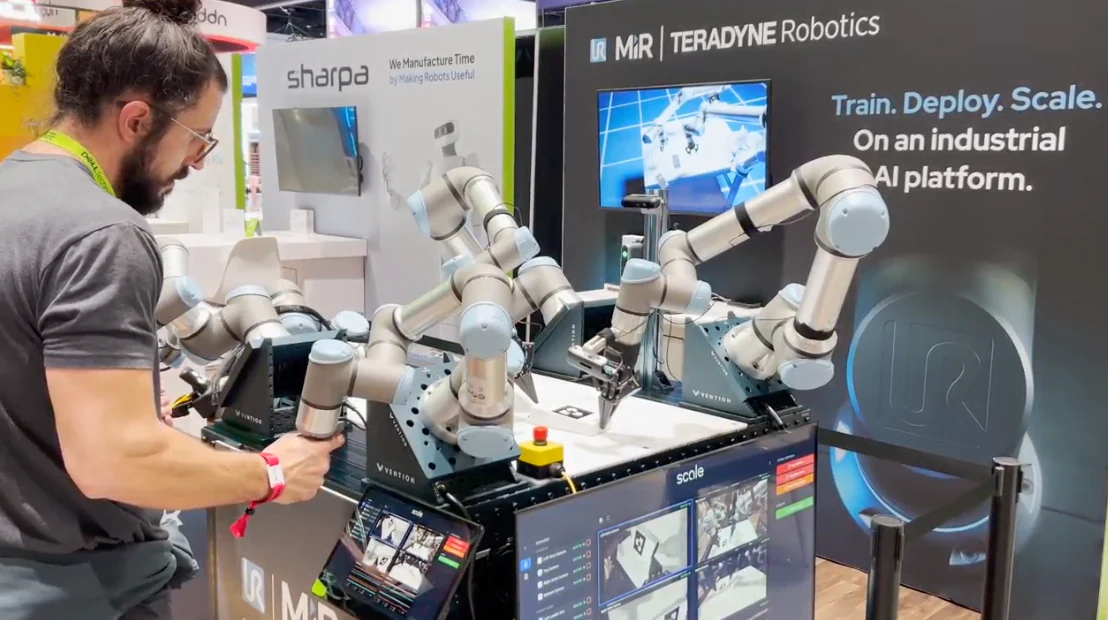
The UR AI Trainer pairs human-guided robot demonstrations with synchronized motion, force and vision data. Developed with Scale AI, the system is intended to train Vision-Language-Action models on industrial robot hardware rather than relying only on research platforms or visual data.
Why training data is the bottleneck
Robots that learn manipulation need examples of successful interaction. Vision explains what the scene looks like, but contact-rich tasks also depend on force, compliance and timing.
UR’s leader-follower setup lets a person guide one robot while a second mirrors the motion. The system records synchronized data that can be used to train and improve an AI model for the target platform.
What could become easier
Imitation learning may reduce the manual effort needed to encode tasks with many small variations, such as flexible packing, handling deformable items or complex assembly. It also creates a path for capturing experienced operator behaviour in a structured form.
The important word is may. Model performance still depends on representative data, validation conditions and how the system handles situations outside its training distribution.
The Multitech view
For production teams, the question is not whether a demonstration looks intelligent. It is whether the learned process meets cycle, quality and safety requirements across realistic variation.
AI-trained applications need a validation plan that includes unsuccessful grasps, unexpected objects, sensor degradation and recovery. The more flexible the behaviour, the clearer the operating boundaries must become.
Practical takeaways
- Force and motion data add context that vision alone cannot provide.
- Train on representative production conditions whenever possible.
- Define performance limits and recovery paths before deployment.
This briefing is an original Multitech editorial summary based on the linked primary source. Product claims and figures remain attributable to that source.